
The Punisher Called
He wants his logo back

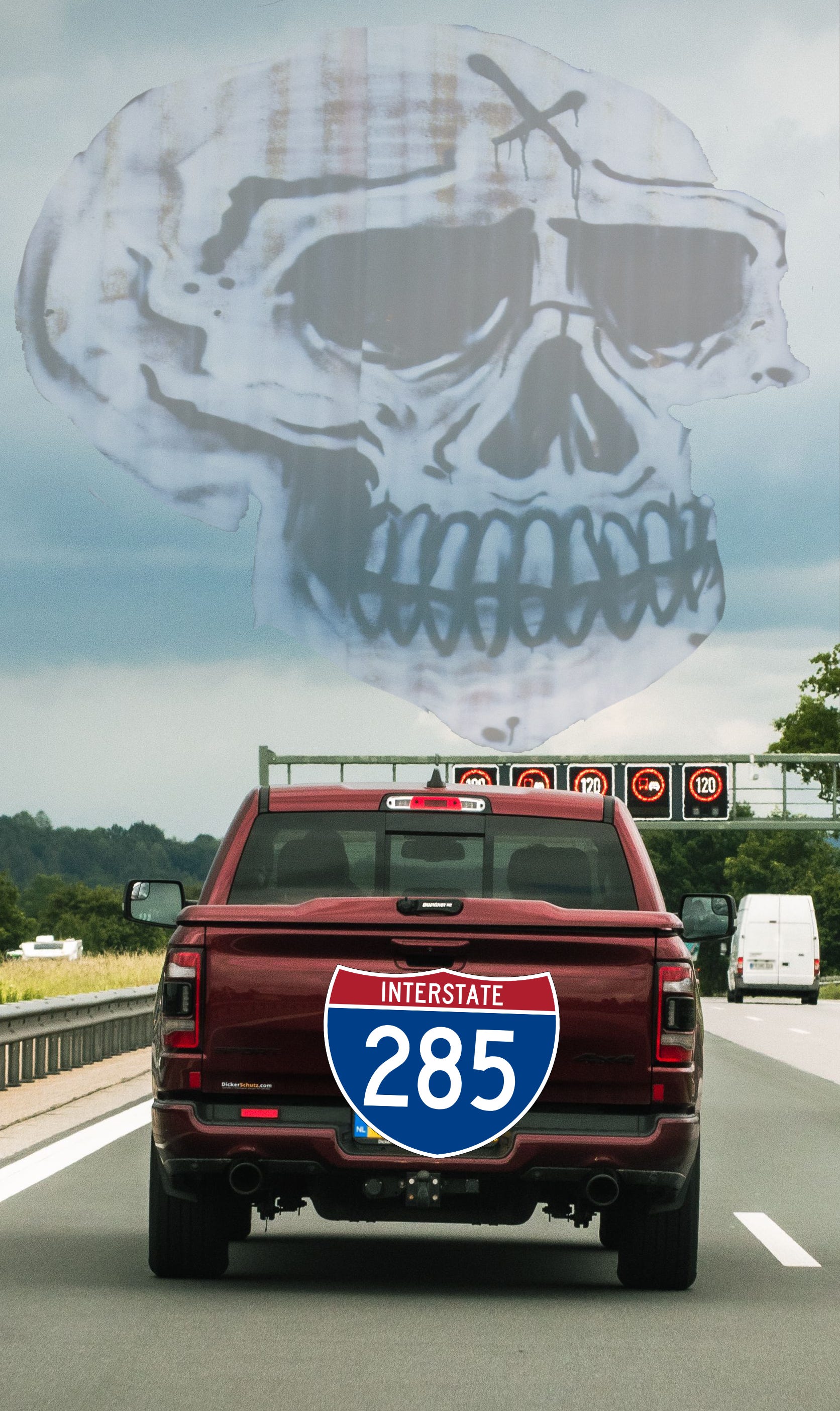
If you haven’t driven in Atlanta, imagine a NASCAR track designed by someone who thought The Road Warrior needed more semis: a sixty-mile circle packed with cars that may have driven off the set of a Vin Diesel movie, vehicles that surrendered to rust sometime during the Clinton administration, and quarter panels held on with duct tape and prayer. All of it moving at speeds that suggest thermodynamics is more of a guideline than a law.
A couple of weeks ago I was tooling down this giant super slab—we call it 285, which is Old English for The Circle of Despair.
Traffic was moderate, which in Atlanta means vehicles were moving anywhere between 45 miles per hour (one cargo van carrying what appeared to be every ladder in the Southeast) and 85 miles per hour. I was in the left lane, traveling slightly above the average, when I spotted a giant pickup truck gaining on me as if it had been launched from a rail gun.
When I say giant, I want you to understand that I could see the driveshaft spinning fast enough to generate its own gravitational field. He got on my bumper like he was conducting a surprise inspection of my back seat.
Nope.
I didn’t need this aggravation, so I signaled and started moving over.
Apparently not fast enough.
Mr. Big Truck swerved around me, saluted with his middle finger, then cut back in front of me close enough that I had to tap my brakes to avoid becoming part of his origin story.
And that’s when I saw it: the giant Punisher skull decal on his back window.
I immediately knew what Mr. Big Truck thought the logo said: I’m tough. I’m rebellious. Don’t mess with me.
The problem is this: Frank Castle would hate this guy.
While the skull may project danger and moral certainty, on this truck it mostly said: I make traffic worse for everyone.
Frank Castle—the Punisher—is a former Marine who declares war on organized crime after his family is murdered.
Castle isn’t happy, healthy, or aspirational. He’s a man so consumed by grief and rage that makes Batman looks like the model of resolved trauma.
The Punisher is not a success story. He is a warning label.
Which is why I was curious about Mr. Big Truck, who by this point had woven in and out of traffic only to end up stopped two cars in front of me at the entrance to the Alpharetta Autobahn.
I wanted to tell him: if you’re displaying a giant Punisher sticker while trying to shove strangers out of your way at 90 miles per hour, I’m not sure you’re identifying with Frank Castle so much as proving his point.
Frank wouldn’t see this guy as a fellow warrior. He’d see a reckless idiot making life more dangerous for everyone around him.
Big Truck Guy thinks he is the Punisher.
Everyone else sees a dentist named Eugene on his way to Costco.
The odd thing is that we do this all the time. We adopt symbols from stories without understanding the story.
The Punisher isn’t a fantasy about justice. It‘s a tragedy about a man consumed by grief and rage. Yet somewhere along the way, the skull escaped the story and became a generic symbol for toughness and rebellion. Once that happened, people stopped asking whether Frank Castle was a hero and started asking where they could buy the decal.
This has happened before. People quote Tyler Durden while missing the point that he’s the villain. Homelander was never the good guy. Walter White was not a small-business success story. If your business plan involves dissolving bodies in acid, the SBA probably isn’t interested. Gordon Gekko was not offering retirement advice.
I should note here that back in the ’80s I owned a shirt that said, “Greed is Good.”
Hey, it was the ’80s. We were all making questionable choices. Parachute pants. New Coke. Hair products that probably violated several environmental treaties. Me? I bought a T-shirt based on a movie villain.
I no longer hold that belief, or own that shirt.
Which, in retrospect, is exactly the point. My terrible T-shirt choice mostly injured my dignity.
Some symbols go further than that.
Perhaps that’s why the Punisher‘s skull became popular in the first place. Not because people wanted to become Frank Castle, but because they recognized the emotion. The details of the story got lost. The anger didn’t.
Spend ten minutes on social media, cable news, or any metro highway and you’ll notice the same thing: everybody is furious.
Not mildly miffed.
Not “somebody took my parking space” annoyed.
Furious.
Eugene was angry. The people yelling at each other on Facebook and Bluesky are angry. The folks convinced every disagreement is proof of stupidity or evil are angry too.
Traffic feels more aggressive. Customer service interactions feel more hostile. Social media rewards outrage so efficiently that we gave it a name: rage baiting. And the news cycle? We might as well call that All the Anger 24/7. Twenty-four hours a day, seven days a week, algorithms deliver outrage directly to the device in your pocket because they’ve learned a simple truth: calm people close apps.
We’ve stopped treating everyday inconveniences as inconveniences and started treating them as personal attacks.
Barista gets our order wrong.
Personal attack.
A stranger disagrees with us online.
Personal attack.
The internet goes down.
Personal attack. Act of war.
When every inconvenience feels like an attack, everybody becomes the enemy.
Outrage is no longer an emotion. It’s an identity. Frank Castle isn’t a celebration of righteous anger. He’s a cautionary tale about what happens when anger is the only thing left.
Eugene wasn’t responding to an actual threat. He was responding to a minor inconvenience. After risking a dozen or so insurance claims, he arrived at the same exit I did about three seconds sooner.
The issue isn’t the truck. It’s the mindset:
The world is full of obstacles. I am the hero. Everyone else needs to get out of my way.
Frank Castle isn’t impressed by your truck, lane position, or swerving skills. If we’re being honest, the only thing Frank and I have in common is that neither of us wants you sporting that logo.
Because Frank Castle was never the hero. He was never meant to be aspirational.
Somewhere along the way, we missed that lesson.
Which is how a grieving fictional vigilante became a decal on Eugene’s pickup truck as he raced toward Costco three seconds faster than the rest of us.
###
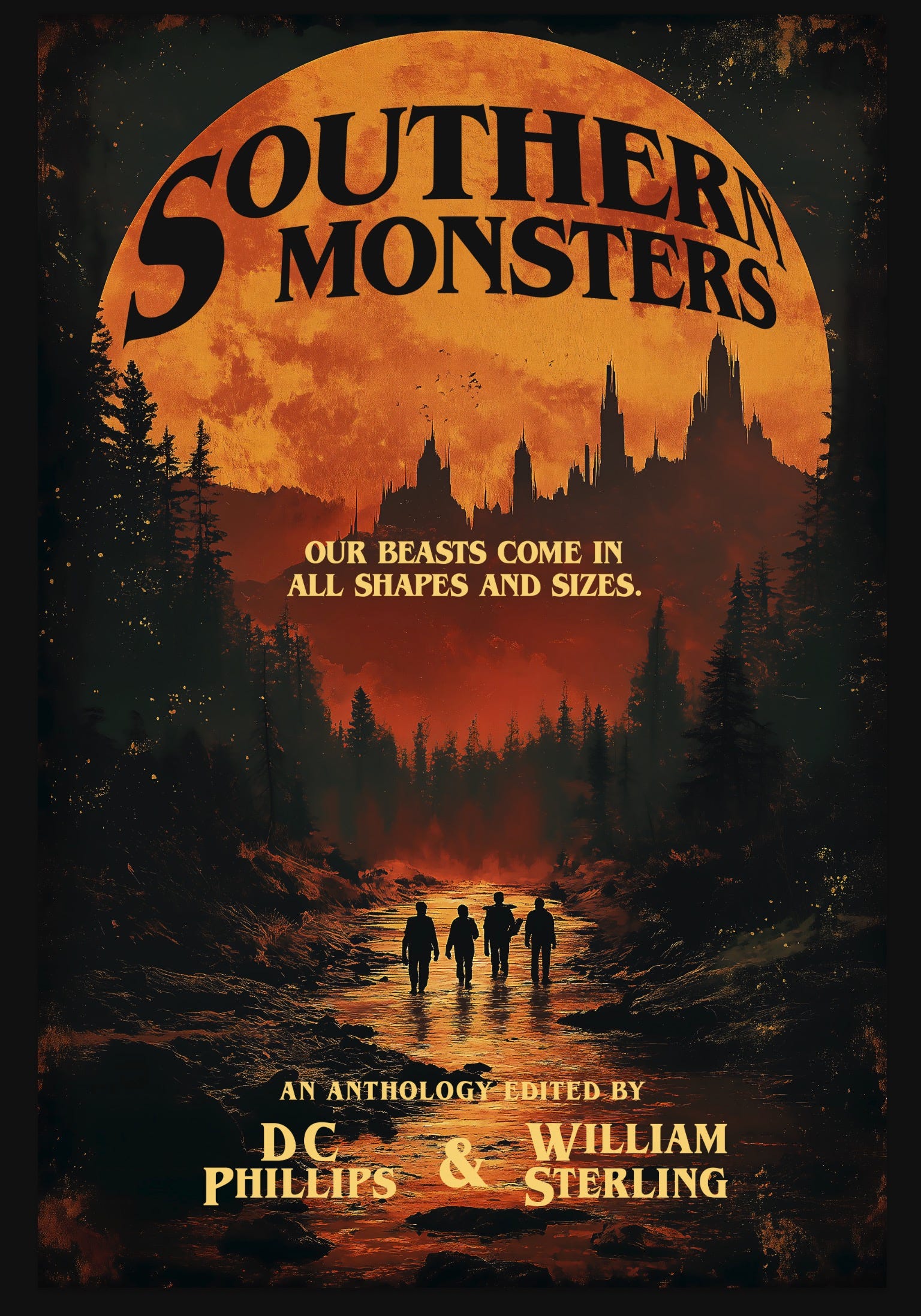
P.S. While we’re on the subject of stories, the cover for the anthology featuring my Southern Gothic tale The Hog Men of Sweetwater Bottom dropped today. I still get a kick out of seeing my name in TOCs. Some things never get old.
Cold Cuts is my weekly column about culture, memory, technology, and the everyday absurdities we’ve somehow agreed to live with. Subscribe if you’ve also suspected that normal life has some explaining to do.
Tony
Photo Credits:
Truck and highway: Dusan Cvetanovic pexels.com
Skull: Daniel Ellis pexels.com
I285: Georgia Department of Transportation