
The Night the Sox Killed Disco
It started as a radio bit. Forty-seven years later, we're still arguing about what it meant.

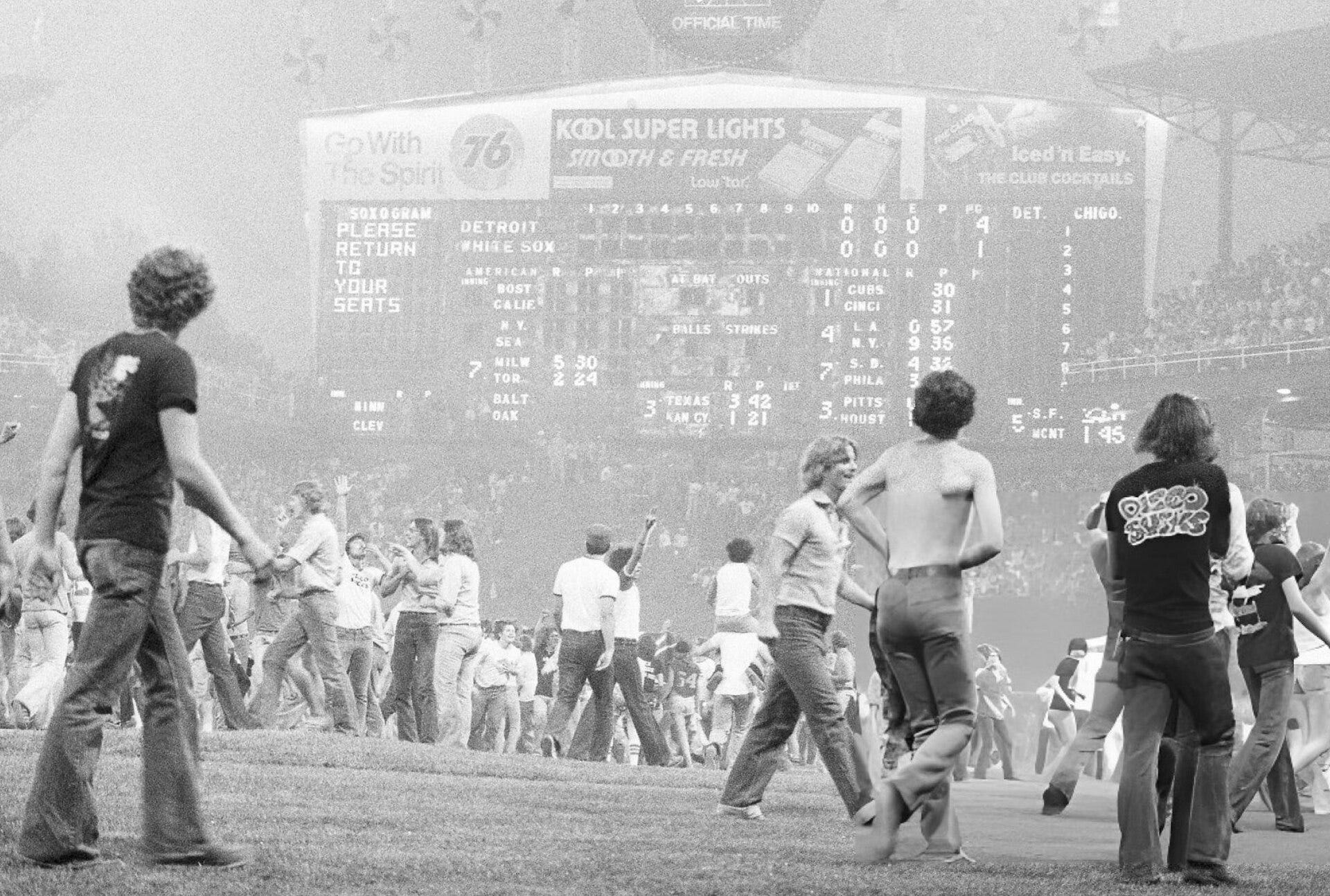
In the summer of 1979, I was a rising senior. Alien was in theaters, malls were bustling centers of capitalism, according to Chamber of Commerce pamphlets, and my favorite TV shows were The Incredible Hulk and Baretta (…don’t do the crime if you can’t do the time — don’t do it). You could still smoke in McDonald’s and — in a marketing disaster that could only have happened in the 1970s — their coffee stirrers, the McSpoons, were perfect not only for adding sugar to your coffee but also for adding snow to your nose. In December of that year, Time would report that cocaine users loved the McSpoon because of its slightly curved design. McDonald’s redesigned the stirrer to be flatter and less useful as drug paraphernalia.
And on the radio? Ah yes, the radio. A few years earlier, you could tune to WABC in New York and hear Lynyrd Skynyrd; Curtis Mayfield, whose socially conscious lyrics came wrapped in smooth R&B and funk; Paper Lace—shut up, I loved their historically questionable “The Night Chicago Died”—and Dolly Parton, who was, well, Dolly Parton, all within a single hour. Top 40 radio was alive and blasting out at 50,000 watts across the New York Metro. But that was then. Now, well, in 1979, an hour of music was brought to you by the Bee Gees: a song written by the Bee Gees, performed by the Bee Gees; a song performed by Andy Gibb (baby brother to the Bee Gees); a song performed by Samantha Sang (written by the Bee Gees); a song written by the Bee Gees performed by Tavares, another song—well, you get the idea. I don’t mean to make it sound like all you heard were the Bee Gees, or some flavor of BG; but it wouldn’t be a stretch to say the Bee Gees owned Top 40 radio thanks to the popularity of 1977’s Saturday Night Fever. SNF was an ode to all things disco, and its influence would dominate music until “My Sharona” by the Knack in late 1979 would signal musical tastes were changing.
Disco music grew out of Black, Latino, and gay dance clubs of the early ‘70s. The DJs at these clubs wanted records that could keep people on the dance floor all night. Producers delivered longer tracks, heavier bass, and arrangements built around a dance floor aesthetic rather than the shorter AM-radio single. The era included Donna Summer, Chic, KC and the Sunshine Band, Gloria Gaynor and the Village People. Sister Sledge recorded We Are Family, one of the defining songs of 1979 and, ironically, the theme of the Pittsburgh Pirates who would go on to win the World Series. But that was still months away. By 1979, even such venerable rock bands as the Rolling Stones and KISS had released disco records. It was easy to see how someone who enjoyed rock radio could feel their musical neighborhood was under attack.
While I continued listening to disco with my girlfriend — I’d slowly been exploring other musical genres. My whole crew had. Angelo was becoming a metalhead. And Gary found the only country music station on the dial: WHN. Thanks to Gary, I learned about the “outlaws” — Cash, Jennings and Haggard. Me — I was drifting toward the songs of the ‘50s and ‘60s. We didn’t hate disco, well, Angelo did, but we’d had our fill of it. We were not alone.
Enter Steve Dahl.
