
The Cost of Clean Thinking
Why I Still Write Like It’s 1899

Listen on Spotify
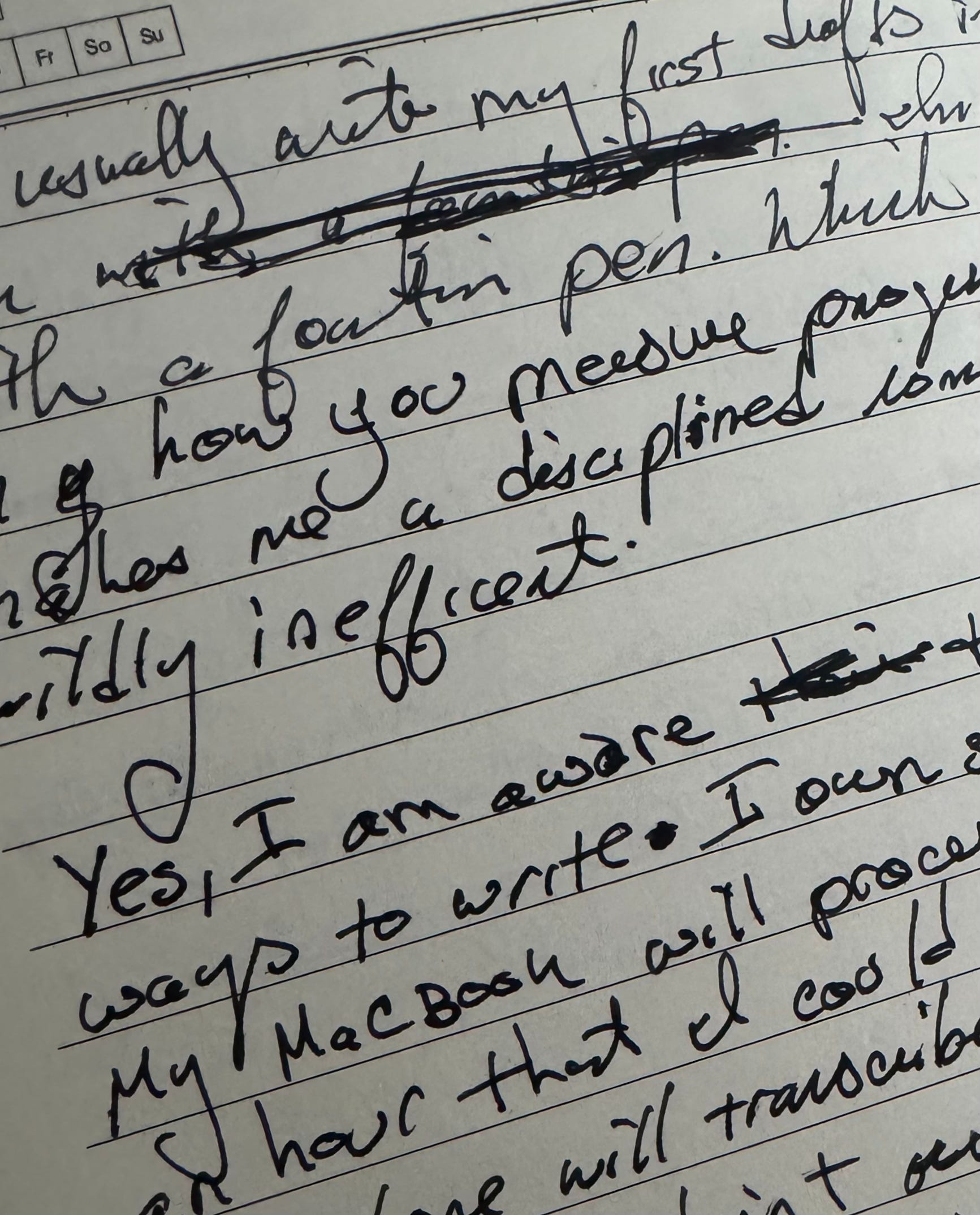
I usually write my first drafts in a notebook, in cursive, with a fountain pen. Which, depending on how you measure progress, either makes me wildly romantic… or wildly inefficient.
It also runs directly counter to every piece of feedback I received in Catholic school—Our Lady of Perpetual Crankiness—where one of my teachers looked at a page of my handwriting, paused, and said it resembled “two chickens fighting on the page.”
This was followed by the helpful prediction that, given my penmanship, success in life would likely remain… aspirational.
Which, in fairness, is a tough note to carry forward. Not “you might struggle.” Not “this could be a problem.” Just—your thoughts, as currently written, are so structurally unsound that they may prevent you from becoming anything at all.
So naturally, I doubled down and bought a nicer pen.
I am aware there are faster ways to write. I own several of them. My MacBook can process more words in a minute than I will write in an hour, and my phone will transcribe my thoughts without complaint or judgment as I walk, drive, or torture myself on what is, for all practical purposes, a Victorian punishment device for debtors.
Yet, when it comes time to start something that matters—or capture my raw thoughts—I reach for a notebook.
Why? Not because it is more efficient. It isn’t. But because cursive (or my odd hybrid of cursive and print) won’t let me cheat.
I cannot easily jump ahead or clean up as I go. Deletion isn’t clean; it’s messy—like a mob hit, full of slashes and arrows. I can only write slower than my brain can process the words. But that gap, between brain and hand, is where the thinking takes place.
When I type, I can easily outrun myself.
I can get to the end of a paragraph before I’ve fully understood what I’m trying to say. The words stack neatly. The sentences look complete. It’s an illusion of progress that comes from seeing clean text appear on a screen, even if the idea underneath it is still half-formed. It feels finished long before it actually is.
That doesn’t happen with cursive.
If a sentence isn’t working, I feel it immediately. My hand slows down. The line wobbles. I hesitate. My brain knows before I do that something went sideways. And when I cross something out, it doesn’t disappear. It stays there—a visible reminder that I tried something and it didn’t land.
There’s no undo button. No clean version waiting underneath the mess.
Just the work.
We’ve spent a lot of time, as a culture, trying to remove that kind of friction. And in most cases, that’s a good thing. Friction slows us down. It introduces errors. It makes simple things harder than they need to be. So we’ve built systems that prioritize speed, clarity, and efficiency.
We moved from cursive to print. From print to typing. From typing to tapping. From tapping to talking. Each step faster, cleaner, more scalable than the last.
And each step a little further removed from the act of thinking something through.
This isn’t a complaint about technology. I love technology. I rely on it. This essay, at some point, will leave the notebook and live in a format that has nothing to do with ink or paper.
That’s not the problem.
The problem is what we decided wasn’t worth keeping.
Cursive didn’t disappear because it failed. It didn’t stop working because it didn’t fit the wetware. We stopped teaching it because it didn’t fit the system.
It’s slower. It’s harder to standardize. It doesn’t scan cleanly. And yes—OCR software hates me. The last time I tried it, the output looked like something that would require the Warrens and two gallons of holy water. It doesn’t translate well to machines. It requires practice—and worse, patience.
And patience is something we’ve been optimizing out of almost everything.
So cursive became optional. Then unnecessary. And now, for a lot of people, unreadable.
That part doesn’t get talked about much.
There are letters—real letters—written not that long ago that a growing number of people can’t read without effort. Not because the words are complicated, but because the form is unfamiliar.
We didn’t just simplify writing. We simplified what we expect from the person doing it.
Now everything is clear. Everything is legible. Everything arrives quickly and looks more or less the same. Your notes look like my notes. Your emails look like my emails. Our thoughts show up in the same font, the same size, the same structure as everyone else’s.
Clean. Efficient.
Interchangeable.
A signature used to be something you developed. It took time. It evolved. It was, in a small but real way, yours. Now it’s often a formality—something you approximate once and then reproduce as quickly as possible, or replace entirely with a checkbox.
“I agree.”
We’ve reduced identity to compliance.
And again, this isn’t a call to bring back cursive classes with the urgency of a man yelling at clouds. But maybe we should.
Most people will be fine without it. Most people are also fine without knowing the Pythagorean theorem, and we still teach that. The world will continue to function. Emails will still get sent. Documents will still get signed.
But something has shifted.
When I sit down with a notebook, I’m thinking. at the speed of my hand. With no shortcuts. No clean version waiting on the other side.
Just a line, followed by another line, followed by the slow realization that the thing I thought I understood is going to take a little longer to get right. It is, by almost any modern metric, wildly inefficient.
And it’s also the only part of the process that doesn’t let me pretend I understand something before I actually do.
If you’ve been reading along and enjoying these essays, consider upgrading to a paid subscription. No pressure—it just helps keep the essays showing up each week.
Tony