
Please Stop Oversharing Near My Fountain Pen
I Can Only Write So Fast

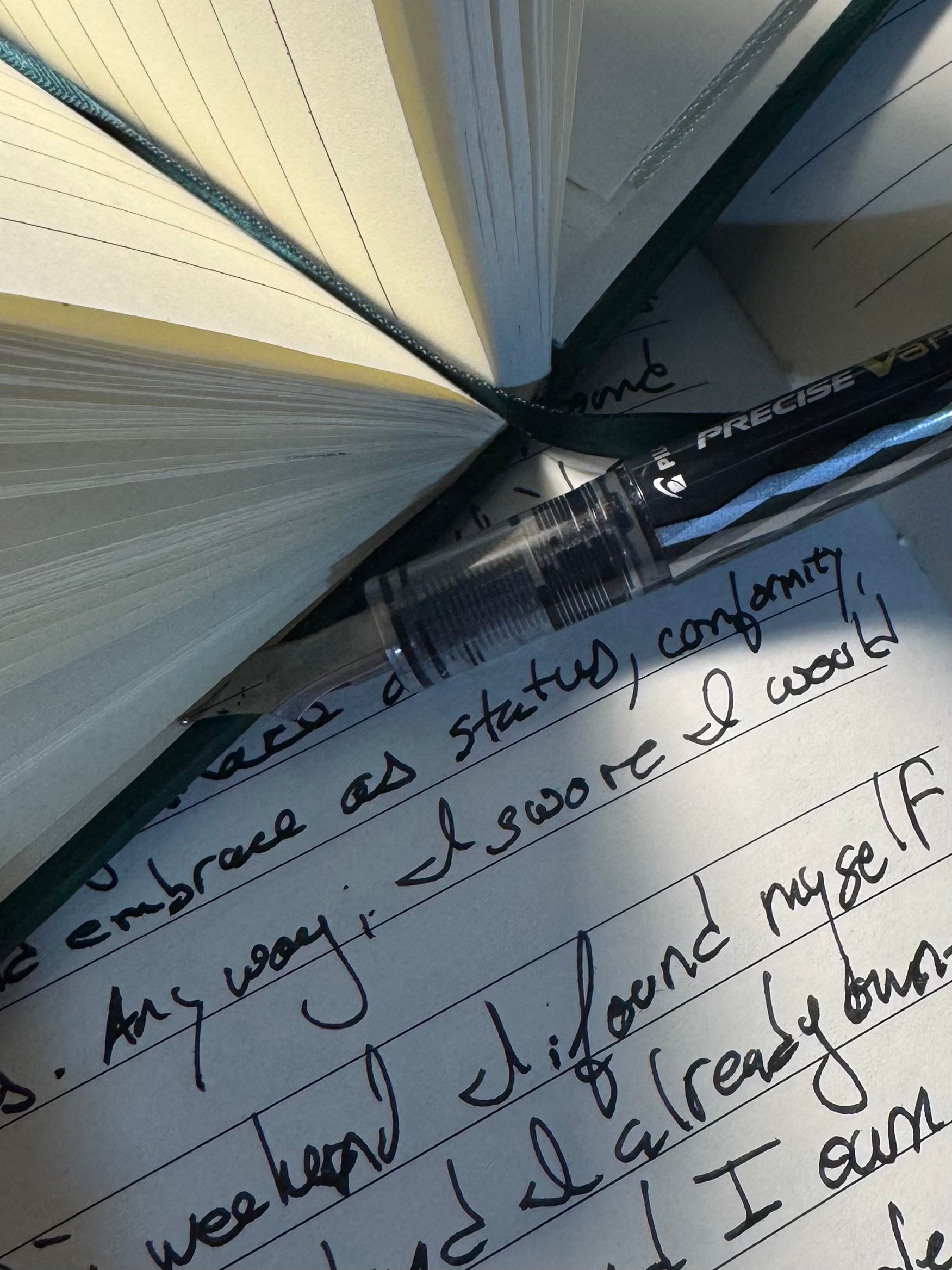
The other day I was sitting in a coffee-shop when I did something that apparently alarms modern society.
I pulled out a notebook and a fountain pen.
Not a phone. Not a tablet. Not a laptop.
A notebook.
You would have thought I’d assembled a ham radio and started transmitting to Moscow.
A few minutes earlier, everyone around me had been discussing marriages, medical issues, office politics, weekend plans, family grudges, and digestive interventions at full coffee-shop volume.
“…my mother still hasn’t spoken to my brother since Thanksgiving.”
“…then my naturopath put me on a liver cleanse.”
“…the colonic changed my life.”
One woman was telling a friend all about her husband’s latest offense, which, from what we all heard, involved either poor judgment, poor timing, or an alarming misunderstanding of what counts as “just giving someone a ride home.”
Everyone at the neighboring tables had become an unwilling supporting cast in this drama of overshares.
We were not eavesdropping.
We had been drafted.
Then I opened my notebook.
The reaction was immediate.
The couple at the next table lowered their voices. A man across the room glanced over twice. Another man, who had been speaking at full volume about his weekend and the life-changing properties of a hazy IPA, suddenly developed operational security protocols.
He went from podcast host to submarine commander in under three seconds.
Nobody said anything, but I could feel the question hanging in the air.
Is the bald guy writing about us?
Which is funny, because until that moment, they didn’t seem especially worried about being overheard. They just didn’t want to be remembered.
That’s the part I can’t stop thinking about.
We are surrounded by surveillance almost every waking moment of our lives. Cameras record us at intersections. Stores track us through loyalty cards. Websites follow us with cookies. Phones know where we are. Doorbells record us walking the dog. Entire industries exist to collect information about us, package it, analyze it, and sell it to someone else.
Most people shrug and take Facebook quizzes anyway. According to the Meta test I just took, I am reincarnated from 8.7 pounds of russet potatoes.
Which, frankly, feels specific.
They’ll pour their souls into an app built by people who name their children after file formats, but let me open a notebook and suddenly I’m Stalker McStalkerson.
A Forbes piece, citing Harvard Business Review’s 2025 list of generative AI uses, put therapy and companionship at number one. That’s a lot of personal information to hand to a machine before getting nervous about a bald potato with a notebook.
Pull out a Moleskine in public and suddenly everyone acts like they’ve spotted a federal agent. Not even a cool federal agent. One of the paperwork agents who wanted receipts from Mulder and Scully.
Why?
Because the camera records everyone.
The notebook records someone.
The camera is automated. The notebook requires a decision. The camera says, “you were present.” The notebook says, “you were interesting.”
And that is a completely different feeling.
The more I think about it, the more I suspect people aren’t actually afraid of surveillance. Not exactly. If we were, we’d at least stop volunteering for so much of it. Wave to the CCTV in any major metro and hope it gets your good side.
No, what makes people uncomfortable is attention.
Specific attention. Human attention. The possibility that another person noticed them and found them memorable enough to write down.
Nobody worries that a traffic camera caught them scratching their nose. But let a writer scribble something after they say, “My liver cleanse pills fixed everything,” and suddenly everyone is concerned about documentation.
The fear is that they might become material.
I know this because I carry a fountain pen.
If notebooks make people uneasy, fountain pens elevate the situation into mild suspicion. A phone is invisible because everybody has one. I could write the same notes about IPA guy on my phone and nobody would blink. But a fountain pen feels intentional.
Nobody accidentally carries a fountain pen.
It’s like arriving somewhere with a falcon on your shoulder.
A fountain pen suggests that you considered all available technologies and said, “No. I prefer liquid ink and a writing instrument that occasionally behaves like a Victorian plumbing system.”
A fountain pen is not just a pen; it is premeditation with a nib.
There may be a generational divide hiding in here. When someone takes out a phone, we assume they’re consuming something. Texting. Scrolling. Watching videos. Arguing with strangers about whether fries count as a vegetable. They should.
A phone suggests communication.
A notebook suggests authorship.
When somebody opens a notebook, we assume they are creating something. Creation carries consequences.
A conversation disappears.
A written account survives.
A joke becomes a story.
An observation becomes an essay.
An awkward encounter becomes evidence.
That possibility sits in the back of people’s minds because deep down, everyone suspects they are one weird sentence away from becoming somebody else’s essay.
Which, to be fair, they probably are.
Pull out a notebook and a fountain pen in a public place and watch people shift in their seats.
Apparently we don’t mind being surveilled.
We just don’t want to end up in somebody else’s first draft.
Which is unfortunate.
Because if you’re explaining why your husband needs two hours to drive the babysitter home, I’m sorry, but you’re already in my notebook.
Cold Cuts is my weekly column about culture, memory, technology, and the everyday absurdities we’ve somehow agreed to live with. Subscribe if you’ve also suspected that normal life has some explaining to do.
Tony