
Netflix Has Accidentally Become the World’s Weirdest Horror Video Store

Listen on Spotify
One of the strangest things Netflix has done—outside of greenlighting twelve different dating shows involving emotionally unstable people trapped on islands—is accidentally become the greatest international horror video store in history.
Twenty years ago, if you wanted to watch an Indonesian horror movie, you needed a guy named Trevor.
Trevor worked at an independent video store with terrible lighting and a Criterion Collection shelf he guarded like a wizard protecting cursed scrolls. He wore fingerless gloves in July and spoke exclusively in phrases like, “The Korean version is better.”
Now?
You’re three clicks away from discovering that somewhere in Indonesia, filmmakers are making zombie movies that feel less like content and more like a warning from an angry god.
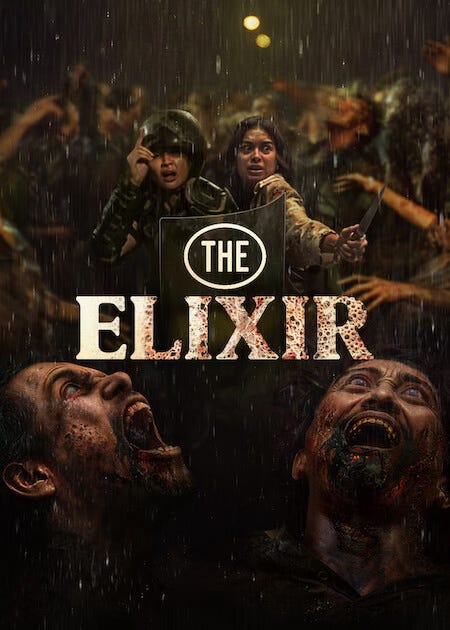
Which is how I ended up watching The Elixir on Netflix.
And within about fifteen minutes, I realized something important:
American zombie stories and international zombie stories are no longer interested in the same fears.
American zombie fiction has evolved into infrastructure horror.
We worry about supply chains. Government collapse. Prepper fantasies. Whether the guy with the tactical backpack and six hundred cans of beans secretly wants civilization to fail just so he can finally explain water filtration systems to his neighbors. Indeed, my own zombie story, The Skin Man, takes place as society is already eating itself and the reanimates show up in time for the main course.
American zombies are, mostly, logistical.
International horror still treats the undead like a curse.
An important distinction.
The Elixir doesn’t feel like it emerged from a Hollywood writers’ room assembled by algorithm to maximize “second screen engagement.” It feels sweaty. Uneasy. Personal. Like the movie itself might be carrying a fever.
And I mean that as a compliment. Seriously, this may be my favorite zombie movie in years. Though, I should note, nothing I’ve seen comes close to Train to Busan, probably the modern gold standard in the zombie genre.
The Elixir taps into one of humanity’s oldest bad ideas: someone invents a miracle cure and immediately discovers that the fountain of youth, much like printer ink subscriptions and Terms of Service agreements, contains hidden complications.
This turns out poorly for everyone.
As it always does.
Every civilization eventually produces a person who looks at mortality and says: “What if we disrupted this?”
The ancient alchemists tried it with mysticism.
Victorian scientists tried it with electricity.
Silicon Valley billionaires are currently trying it with blood transfusions, supplements, and whatever terrifying powder Joe Rogan’s guests are selling this week.
We keep repackaging the same fear in different branding.
The philosopher’s stone.
The fountain of youth.
Cryogenic freezing.
Then Silicon Valley briefly convinced itself eternal life might somehow involve buying a haunted JPEG.
At some point every generation rediscovers the same horrifying truth: the line between medicine and curse is often just dosage and marketing.
This film is not for the squeamish; packed with kills that would make any horror fan grin with deeply concerning enthusiasm while making casual viewers squirm and question the life choices that led to this moment. There’s even an amusing and graphic nod to Bicycle Girl from the pilot of The Walking Dead.
The Elixir understands something American horror occasionally forgets while trying to set up cinematic universes: Body horror works because your body already feels vaguely unreliable.
By the age of forty, every human being wakes up making at least one sound associated with a haunted wooden ship. Aging is already cosmic horror. Which is why immortality stories work.
International horror often plays this more directly than American horror does. Hollywood tends to cushion terror with irony now. Every third character talks like they know they’re in a movie, quipping through the apocalypse like they’re contractually obligated to have at least three “trailer quotes”.
But The Elixir has moments that feel genuinely uncomfortable in the way older horror movies used to.
Not “elevated horror.”
Not “prestige horror.”
Just: “Oh no. Something has gone catastrophically wrong and people are absolutely not emotionally equipped to deal with it. Not unlike the Windows 11 rollout.”
There’s also something refreshing about watching horror built from different cultural instincts. American zombie fiction usually begins with societal collapse.
International horror, like Thanksgiving disasters, often begins with family.
Obligation.
Shame.
Tradition.
Community pressure.
The fear that the people closest to you may drag you into terror because they cannot let go of something they desperately want to believe.
Especially after the last decade, where many of us discovered a shocking number of people would absolutely drink mystery supplements purchased from a podcast host standing in front of an elk carcass.
The older I get, the more I think horror survives by migration.
The genre has to keep traveling.
Country to country.
Culture to culture.
Otherwise it becomes trapped inside its own habits.
American zombie fiction gave us George A. Romero.
Then The Walking Dead.
Then approximately four thousand scenes of trauma survivors reinventing feudalism beside abandoned propane tanks.
Now horror is mutating again.
Korean horror.
Indonesian horror.
Spanish horror.
Folk horror.
Tech horror.
Tiny movies made by people who still seem genuinely interested in scaring you instead of launching a franchise roadmap.
Netflix may not have meant to build the world’s weirdest horror aisle. But it did. And right now, that aisle is more interesting than half the polished franchise machinery Hollywood keeps bolting together.
And maybe that’s the healthiest thing streaming accidentally gave us.
Not infinite content, but new nightmares.
Because eventually every culture invents its own version of the same bad idea: cheating death. And horror exists largely to remind us that this tends to end poorly.
The Elixir is streaming on Netflix. I give it five undead out of five and highly recommend.
If you’ve been reading along and enjoying these essays, consider upgrading to a paid subscription. No pressure—it just helps keep the essays showing up each week.
Tony