
Everything Is a Subscription, Including You
It’s just a couple of bucks

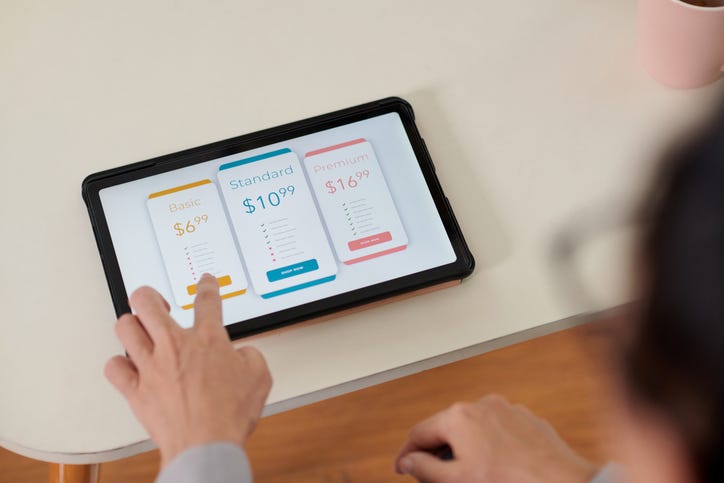
I tried to cancel something the other day.
Not a major thing. Not a mortgage. Not health insurance. Not one of those services where you have to decide whether keeping your family alive is worth the silver-tier plan.
Just one of those minor charges that shows up every month like a friendly relative with their hand out.
“It’s just a couple of bucks,” they say, while quietly reaching into your checking account and taking enough money to buy a gas station coffee and maybe one sad banana.
The cancellation process took three menus, a password reset, two confirmation screens, and what felt like a brief conversation with someone trained in emotional hostage negotiation.
“Are you sure you want to leave us?”
I don’t know, Kyle from Retention, I’m not even sure how this started.
Actually, I do.
We used to buy things.
One and done. Shake hands. Move on with your life.
You bought a CD, and then you had the music. You bought software, and it lived on your computer like a well-behaved citizen. You bought a car, and the features came with it, because apparently there was once a time in this country when heated seats were not treated like premium cable.
There was a beginning, a middle, and an end to the transaction.
Now?
Now we subscribe to it.
Music. Movies. Software. Storage. Fitness apps. Meditation apps. Note-taking apps. Apps that help you organize the other apps. Features that were free last year but now live behind a tiny velvet rope.
We didn’t stop owning things all at once.
We just started renting them a little at a time.
Two dollars here.
Five dollars there.
Seven ninety-nine, which is legally different from eight dollars because marketing people have calculators and no shame.
Small enough that it doesn’t feel like a decision.
It’s just a couple of bucks.
Until one day you look at your bank statement and the slow dread of understanding hits you:
Nothing you thought you owned is really yours.
You’re just paying the companies not to take it away.
According to a C+R Research survey, the average American spends around $273 a month on subscriptions—and most of us underestimate that number by about half.
Which means a lot of us are walking around thinking, “Oh, I probably spend eighty bucks,” while our bank account stands in the corner, dressed like a raccoon, holding a flashlight and whispering, “Buddy, you may want to sit down.”
We don’t buy things anymore. We maintain access.
And access has rules.
Access can be revoked or changed without asking you. Access can get moved behind a different tier while you are asleep, because somewhere a spreadsheet got promoted.
BMW briefly tried charging a monthly fee for heated seats.
Not installing them.
Turning them on.
The technology was already in the car. All you needed to do was pay a monthly service charge, and Germany would grant your backside temporary access to warmth. Which does sound like the epitome of German engineering: precise, efficient, and somehow still requiring paperwork.
They backed off after the backlash.
But the idea stuck.
Because it wasn’t really about heated seats.
It was about proving something.
Ownership is optional now.
Access is negotiable.
And the customer is not the owner.
The customer is the recurring revenue event.
Zuora says the subscription economy has grown over 400 percent over the past decade, which is business language for “every company looked at Netflix and asked, what if toothbrushes worked like this?”
It’s not just pricing.
It’s design.
The trick is simple: keep the cost small, keep the billing automatic, and make canceling annoying enough that people decide to deal with it after lunch, which is where good intentions go to die.
“Pause instead?”
“Try a lower tier?”
“Are you sure you want to lose access?”
“Would you like to tell us why you’re leaving?”
No, I would not. I would like to leave. That was the purpose of clicking the button marked “cancel,” a word that used to mean something before it became the opening move in a negotiation.
And besides—
It’s just a couple of bucks.
So we stay.
Not because we use it, because we might.
And “might” has become one of the most expensive words in the English language.
I have one of these.
A social media scheduling app.
Not a big one. Just something that lets me queue up posts across eight different accounts like I’m running a small digital empire instead of a middle-aged man trying to convince people on the internet that lawns are suspicious and fountain pens are still relevant.
I use it twice a year.
Right before Dragon Con and Multiverse, when it feels important to look organized and professional for about ten days.
The rest of the year?
It just sits there.
Billing me in the background.
Not much.
Just a couple of bucks.
Now and then I think about canceling it. I open the account page with purpose. I square my shoulders. I become, for one brief shining moment, a man of action.
Then the voice arrives.
What if you need it?
What if, against all available evidence, you suddenly become the person who schedules a month’s worth of content across eight platforms?
What if this is the moment everything changes?
What if tomorrow you wake up as a disciplined media professional with a content calendar, a brand strategy, and pants with no dog hair on them?
So I keep it.
Not because I use it.
Because I like the idea that I could.
That’s how they get you.
Not through greed. Not even through laziness.
Through the small, embarrassing belief that a subscription might be a bridge to the better version of yourself.
The fitness app is not just an app. It is Future You with visible abs.
The language app is not just an app. It is Future You ordering coffee in Paris without panicking.
The cloud storage plan is not just storage. It is Future You, organized and serene, with all your photos sorted into folders instead of sitting in a digital junk drawer labeled “Phone Dump 2018 Maybe.”
The scheduling app is not just a scheduling app.
It is Future Me, successful, efficient, and somehow awake after 9:30 p.m.
So I keep paying.
Maintaining access to things I don’t use, features I forgot about, and versions of myself that have not returned my calls.
And now we subscribe to our own lives.
Nothing got better.
It just got easier to bill.
And easier to forget.
Until you look at your bank statement long enough for the pattern to emerge.
Line after line.
Small charges.
Endless continuity.
A streaming service you signed up for because one show looked interesting. A newsletter you meant to read. An app that promised to fix your sleep, your habits, your posture, your inbox, your attention span, and possibly your relationship with your father.
Each one is small enough to ignore.
Together, they become a lifestyle.
And eventually the realization lands:
You’re not buying anything anymore.
You’re paying to keep access to things you might use someday.
After all—
it’s just a couple of bucks.
And somewhere in the dark, the raccoon with the flashlight is going through your bank statement, shaking his tiny head.
Cold Cuts is my weekly column about culture, memory, technology, and the everyday absurdities we’ve somehow agreed to live with. Subscribe if you’ve also suspected that normal life has some explaining to do.
Tony
It began with shareware and vehicle leasing.
Good to see you on Substack! I read and comment…no writing,